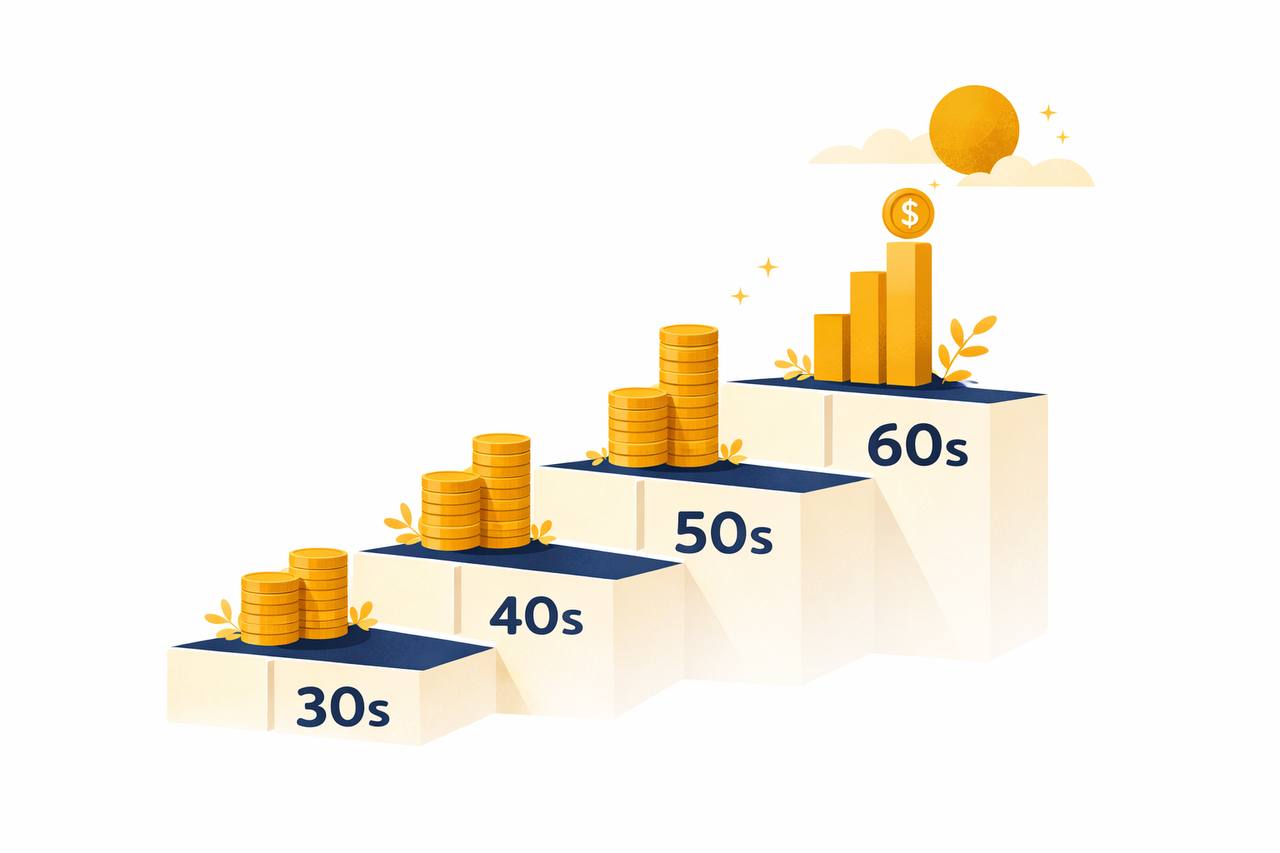
The Fidelity Benchmarks: Your Age-by-Age Targets
Fidelity Investments publishes the most widely-referenced retirement savings benchmarks in the country. Their methodology: compare savings to your current income, assuming a retirement at 67, a 45-year career starting at 22, a savings rate of at least 15% (including employer match), and a retirement spending goal of roughly 55–80% of pre-retirement income (supplemented by Social Security).
Here's the core milestone table:
| Age | Savings Target | Example (at $80K salary) |
|---|---|---|
| 30 | 1× annual salary | $80,000 |
| 35 | 2× annual salary | $160,000 |
| 40 | 3× annual salary | $240,000 |
| 45 | 4× annual salary | $320,000 |
| 50 | 6× annual salary | $480,000 |
| 55 | 7× annual salary | $560,000 |
| 60 | 8× annual salary | $640,000 |
| 67 | 10× annual salary | $800,000 |
Why These Are Guidelines, Not Rules
The Fidelity benchmarks are useful orientation points, but they have significant limitations worth understanding:
They're Income-Based, Not Spending-Based
Your income doesn't determine how much you need in retirement — your spending does. A high earner who saves 40% of their income needs far less saved (relative to salary) than someone spending 90% of their paycheck. If you earn $150,000 but live on $60,000, the 10× benchmark would have you saving $1.5 million when you might only need $1 million.
They Assume a Specific Retirement Age
Fidelity's model targets retirement at 67. If you want to retire at 60, you need more saved. If you'll work to 70, you need less. Always calibrate benchmarks to your actual target retirement age.
They Don't Account for Social Security Variation
The benchmarks assume you'll receive Social Security benefits at a typical level. But benefits vary widely based on your earnings history, whether you've worked in covered employment, and when you claim. Run your personal Social Security estimate at SSA.gov to know what you'll actually receive.
What to Do If You're Behind
Most Americans are behind the Fidelity benchmarks — especially in their 30s and 40s when competing financial priorities (housing, children, debt) consume income. Here's how to close the gap:
Maximize Catch-Up Contributions (Age 50+)
Once you turn 50, the IRS allows higher contribution limits — specifically designed for people who are behind:
- 401(k)/403(b): Regular limit $23,500 + $7,500 catch-up = $31,000/year
- IRA (Traditional or Roth): Regular limit $7,000 + $1,000 catch-up = $8,000/year
- Total potential annual tax-advantaged savings: $39,000/year
Someone who maxes out $39,000/year from age 50 to 67 would accumulate approximately $1.2 million in additional savings (at 7% returns), even starting from zero at 50.
Increase Your Savings Rate Aggressively
The most reliable path to closing a savings gap is a higher savings rate. Every 1% increase in savings rate meaningfully accelerates your timeline. Practical ways to accelerate:
- Direct at least 50% of every raise to retirement savings before lifestyle inflation creeps in
- When a debt is paid off (car, student loan), redirect those payments to retirement
- Cut one major recurring expense — cable, unused subscriptions, eating out — and auto-invest the difference
Consider Working 2–3 Years Longer
Extending your working years is one of the most powerful moves available. Each additional year of work does three things simultaneously: you add contributions, your existing savings compound for another year, and you reduce the number of years your portfolio must support you. Working to 67 vs. 65 can reduce required savings by 15–20%.
Optimize Social Security Claiming
Delaying Social Security from 62 to 70 increases your monthly benefit by approximately 76%. For a married couple, a coordinated claiming strategy (one spouse claims early, the other delays) can add hundreds of thousands in lifetime benefits — reducing the amount your portfolio must generate.
🧮 Are You On Track?
Enter your current age, savings, and income to see exactly how your situation compares — and what it takes to reach your retirement goal.
Check Your Progress →Savings Benchmarks for Specific Situations
High-Income Earners ($150K+)
Income-based benchmarks become less meaningful at high incomes because your Social Security replacement rate drops and your lifestyle spending may be higher. High earners should use spending-based planning: calculate your expected annual expenses in retirement, multiply by 25, and work backward from there rather than using salary multiples.
Self-Employed Workers
Without employer-sponsored plans, self-employed individuals often have access to Solo 401(k) or SEP-IRA accounts with much higher contribution limits. A Solo 401(k) allows contributions of up to $69,000/year (2025) between employee and employer contributions. This can dramatically accelerate savings for high-income self-employed people.
Two-Income Households
The salary-multiple benchmarks apply to each individual. A couple where both earn $70,000 and are 40 years old should collectively have 3× each person's salary saved — $420,000 combined. Two Social Security benefits also significantly reduce the portfolio burden.
Frequently Asked Questions
Sources & References
- Fidelity Investments — Savings Benchmarks by Age — Source for the official 1×/3×/6×/8×/10× salary savings milestones
- Vanguard — How America Saves — Annual survey of retirement preparedness, contribution rates, and account balances by age
- Federal Reserve — Survey of Consumer Finances — Triennial survey with median and mean retirement account balances by age cohort
- Social Security Administration — Retirement Benefits — Benefit estimates and claiming strategy resources